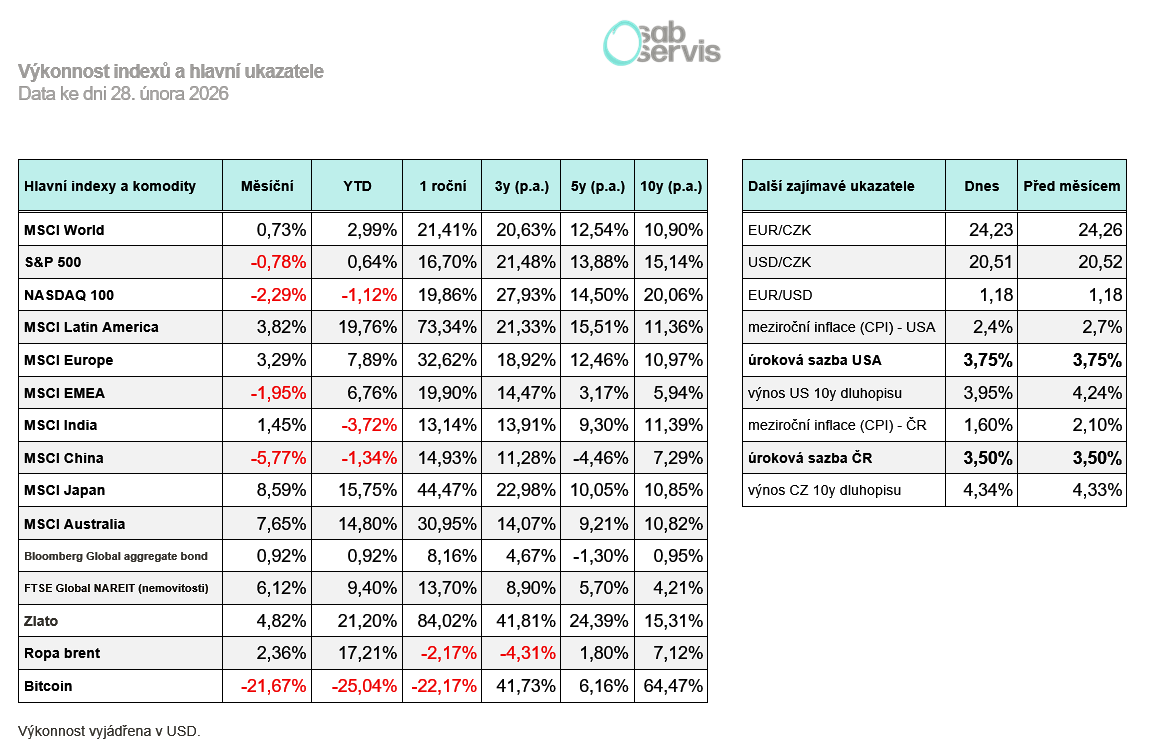
Main events:
• Another war conflict has broken out
• A U.S. court abolished the tariffs introduced by Trump
• Inflation in the Czech Republic below 2%
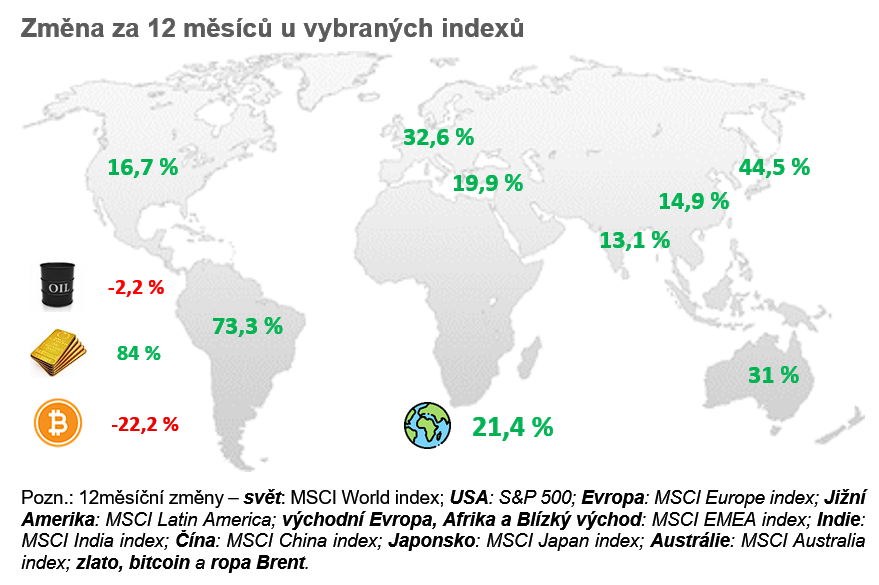
Summary of the current situation:
Traditionally, quite a lot happened over the last month. First, the U.S. Supreme Court ordered the cancellation of the tariffs introduced by Trump and declared them unlawful. However, Trump responded by introducing new tariffs based on another law, and these will remain in force again until the court intervenes. Selected tariffs will thus gradually start returning, together with interest, back to the countries from which they were paid.
But the main topic now is the attack by the USA and Israel on Iran, which began on Saturday, 28 February 2026. According to Donald Trump, this is a preventive attack on a country that does not want to abandon the illegitimate development of nuclear weapons. So far, the USA has managed to neutralize their supreme leader Khamenei as well as other members of the leadership.
Iran is, however, logically defending itself, firing retaliatory missiles at Israel, but also at surrounding states and destroying American bases. Debris also hit, for example, Dubai, which is thus losing its reputation as a safe haven. At the same time, Iran is trying to close the so-called Strait of Hormuz, which is responsible for 20% of global oil imports.
The price of oil has been rising sharply since the beginning of the conflict, climbing from USD 67 to as much as USD 90. There is increasing talk that another inflationary wave could occur due to rising oil prices and, consequently, a lost decade on the stock markets. However, we are still far from that, and the USA, with its up to 20% share of global oil production, is in a better situation than it was in the 1970s.
How did the stock markets react? So far, nothing extraordinary; on Monday after the war conflict began, they even rose slightly. By the end of the week, the S&P 500 index had declined, but it is still only 4% below recent highs. Investors therefore do not expect a greater escalation of the conflict. But even if that did happen, for us as long-term investors it would be an opportunity.
And how did the other assets perform? After the sell-off in precious metals, both gold and silver stabilized, and gold even rose thanks to the conflict to as much as USD 5,300. In the following days, however, gold was also among the assets that investors sold, and it fell to roughly USD 5,000.
After falling to as low as 60,000, Bitcoin is slowly returning back, and even in the last week since the conflict began, it rose to as much as USD 73,000. We are now at a level of around USD 68,000.
Macro summary:
The year-on-year inflation rate in the Czech Republic for January came in at 1.6%. The cancellation of the fee for supported energy sources in the electricity price calculation had a significant effect on inflation falling below 2%. For the whole of 2025, average inflation amounted to 2.5% and thus continues to show a downward trend.
January unemployment data in the USA ultimately came in at 4.3%, in line with expectations.
Trump has also now officially proposed appointing Kevin Warsh as the new head of the Fed. His appointment should take place during May.
The year-on-year inflation rate for January in the USA came in again at 2.4%, which was a positive surprise. For the whole of 2025, average inflation amounted to 2.7% and thus continues to show a downward trend compared to previous years.
As for the year-on-year inflation results in Europe, for the month of January it came in at 1.7%, in line with expectations. Average inflation for 2025 in the eurozone amounted to 1.9%.
Czech Republic:
The year-on-year inflation rate in the Czech Republic for January came in at 1.6%. The cancellation of the fee for supported energy sources in the electricity price calculation had a significant effect on inflation falling below 2%. For the whole of 2025, average inflation amounted to 2.5% and thus continues to show a downward trend.
The average interest rate agreed on mortgages is still moving slightly below 5%, at 4.93% for February.
Yield on 5-year Czech government bonds
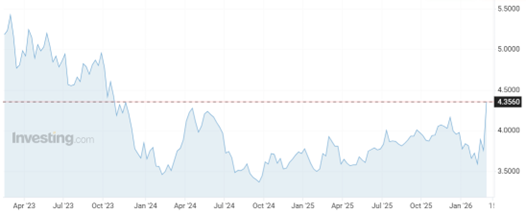
Source: investing.com
However, a growing problem is the rising yield on 5-year and 10-year government bonds, where specifically the 5-year yield rose from 3.7% to the current 4.3%. The reason is the war conflict in the Middle East, the rising oil price, and expected higher inflation.
If inflation were to rise and approach 3%, then the Czech National Bank would probably be able to start raising interest rates again. But it is still too early for such conclusions.
USA:
The year-on-year inflation rate for January in the USA came in again at 2.4%, which was a positive surprise. For the whole of 2025, average inflation amounted to 2.7% and thus continues to show a downward trend.
January unemployment data in the USA ultimately came in at 4.3%, in line with expectations.
Trump has also now officially proposed appointing Kevin Warsh as the new head of the Fed. His appointment should take place during May.
The price of oil has been rising sharply since the beginning of the conflict, climbing from USD 67 to as much as USD 90. There is increasing talk that another inflationary wave could occur due to rising oil prices and, consequently, a lost decade on the stock markets. However, we are still far from that, and the USA, with its up to 20% share of global oil production, is in a better situation than it was in the 1970s.
Development of the Crude Oil price (American)
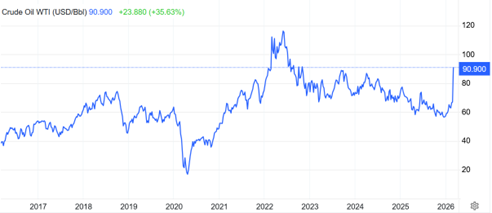
Source: www.www.tradingeconomics.org
The S&P 500 index declined slightly during February, specifically by –0.78%. Since the beginning of the war conflict, it has fallen by several %, but is more or less holding up, and we are now roughly 4% below the highs, which is almost nothing.
Europe:
As for the year-on-year inflation results in Europe, for the month of January it came in at 1.7%, in line with expectations. Average inflation for 2025 in the eurozone amounted to 1.9%.
European indices continue their growth, and in February the MSCI Europe index gained 3.29% in dollar terms. Europe is doing well mainly due to sector rotation from technology companies into more value-oriented and dividend-paying firms.