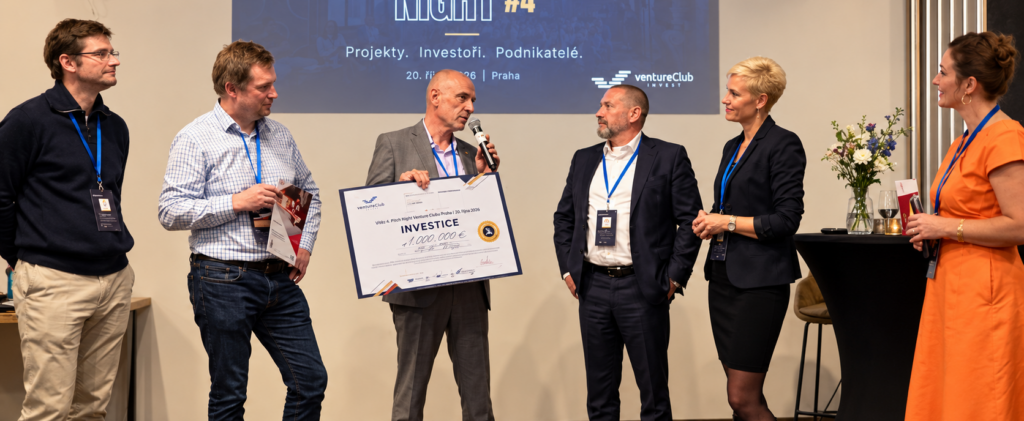
The winner of Venture Club’s 4th Pitch Night was RISTRE, a project that develops and manufactures functional foods. Among the five finalists, it was the only project whose main product was not technology. Nevertheless, it received the most investor votes and also took home the audience award.
But the fourth Pitch Night, held on October 20 in Prague, was not just about choosing a winner. It also offered an interesting perspective on where the startup scene is heading and the role artificial intelligence plays in it today.
AI agents are increasingly becoming the very foundation of new business ventures. Rapid technological advances make it easier than ever to create a new software product. At the same time, however, it is becoming increasingly difficult to come up with something competitors cannot replicate within a few months.
What does this mean for startups seeking investors? And how do investors today identify a project with long-term potential?
These questions ran throughout the evening – from the opening presentation by Marek Miltner from PangeAI to the pitches by the five finalists and the investors’ deliberations.
From industry through software to AI agents. Where is the startup scene heading?
How is the environment in which new companies emerge changing today? This was the subject of the opening presentation by Marek Miltner, co-founder of PangeAI, a technology startup in which Venture Club members recently invested CZK 5.2 million.
Marek offered an interesting perspective on the evolution of successful companies from Central and Eastern Europe. While industrial companies such as Baťa, Škoda and Tatra dominated the region before 1990, software companies such as Skype, Avast, ESET and UiPath rose to prominence in the decades that followed.
According to Marek, the period after 2020 marks the beginning of another stage – the era of agentic artificial intelligence (Agentic AI) and deep tech. He cited ElevenLabs, E2B and PangeAI itself as examples of this generation.

But the change is not just about the new products being created. Artificial intelligence is also beginning to replace the software on which the previous generation of technology companies was built. AI agents can already independently carry out entire workflows that previously required specialized applications and human operators.
This brings enormous opportunities for startups, but also a new risk. If AI makes it possible to create a working product within a few weeks or months, what is to stop competitors from offering a very similar solution?
For investors, the question of what constitutes a company’s true competitive advantage is therefore becoming increasingly important. This could be unique data, proprietary technology, deep knowledge of a particular industry or the ability to quickly establish a strong market position.
And to what extent is this shift already reflected in projects seeking investors? The applications for this year’s Pitch Night offered an interesting answer.
What did the Pitch Night applications reveal about the startup scene?
The applications for the 4th Pitch Night themselves also painted an interesting picture. Of the 25 projects evaluated, approximately one-third were built on artificial intelligence or used it as an important part of their solution. AI featured in social media management, business processes, financial services and education.
Alongside them, however, there were also applications from projects in energy, food production, new materials and industrial technologies. The selection thus offered an interesting cross-section of the ideas entrepreneurs are bringing to investors today.
Simply using AI is no longer an automatic competitive advantage. The more accessible the technology becomes, the more important it is what a company can build on it – and whether customers will be willing to pay for its solution.
RISTRE: A functional food project takes the win
In the end, the most investor votes went to RISTRE, presented on stage by founder Damien Thorn and new CEO Andrea Doležalová.
RISTRE develops and manufactures functional foods for people who want a nutritionally balanced meal on hand without any preparation. Its main product contains 60 ingredients, including 22 superfoods, and was developed in collaboration with 1. lékařská fakulta Univerzity Karlovy. The company already sells through its own online store and business partners and is seeking an investment of EUR 750,000 to EUR 1 million to further develop production, marketing and international expansion.

“Ristre has an established distribution network, an existing, proven product, and a team recently strengthened by a prominent leader tasked with managing expansion into international markets, alongside an enthusiastic founder who has already invested more than CZK 12 million in the project.
If it secures the funding and fulfills its stated ambitions, it has all the prerequisites for scaling; the market exists.
Specialized nutrition can be useful not only for athletes and the military, but actually for anyone who would like to keep a few packs at home as an emergency reserve for any eventuality.
These reasons led us to decide to support the project for further evaluation and presentation at Den D. We are seriously considering an investment.”

Petr Šedivý
Jury member at Pitch Night #4 and CEO of Venture Club Invest
RISTRE also took home the audience award. Perhaps the tasting the team offered attendees when the evening’s program ran longer than expected helped a little too 🙂
AI projects took second and third place
Second place went to Artima by David Fogl, which uses AI agents for content creation and social media management. Third place went to Valuneto, presented by Jiří Heinrich, which uses AI in personal finance.
Both projects demonstrated potential, but also challenges typical of today’s startup scene. Artima is entering a highly competitive market where similar solutions are rapidly multiplying. Valuneto is still at an earlier stage of development and needs to validate its business model further.
Both teams were awarded three expert consultations – with Kamil Vaniš from BDO, Ondřej Lipold from Tensor Ventures and a Venture Club representative. The consultations can help them take their projects further and better prepare for discussions with investors.
This is precisely one of the goals of Pitch Night – not just to choose a winner, but also to help promising projects grow. And who knows, perhaps we will meet some of them again at a future investment opportunity?
Pitch Night is not the end for RISTRE. The next step is Den D
Winning Pitch Night does not yet mean securing an investment. For RISTRE, however, it opens the door to the next step – a detailed presentation of the project to Venture Club investors.
On Tuesday, November 3, we will meet RISTRE again at Den D at our premises in Prague’s Modřany district. This time, we will go into greater depth – from the business model and financial results to the growth strategy and the terms of a potential investment.
Are you interested in RISTRE as an investment opportunity? Come and get to know the project in person, meet its leadership and ask the questions that were not covered during the short Pitch Night presentation.