Main events:
• Final agreement in Iran?
• CNB raises interest rates to 3.75%
• Interest rate hikes in the US are likely to follow
Summary of the current situation:
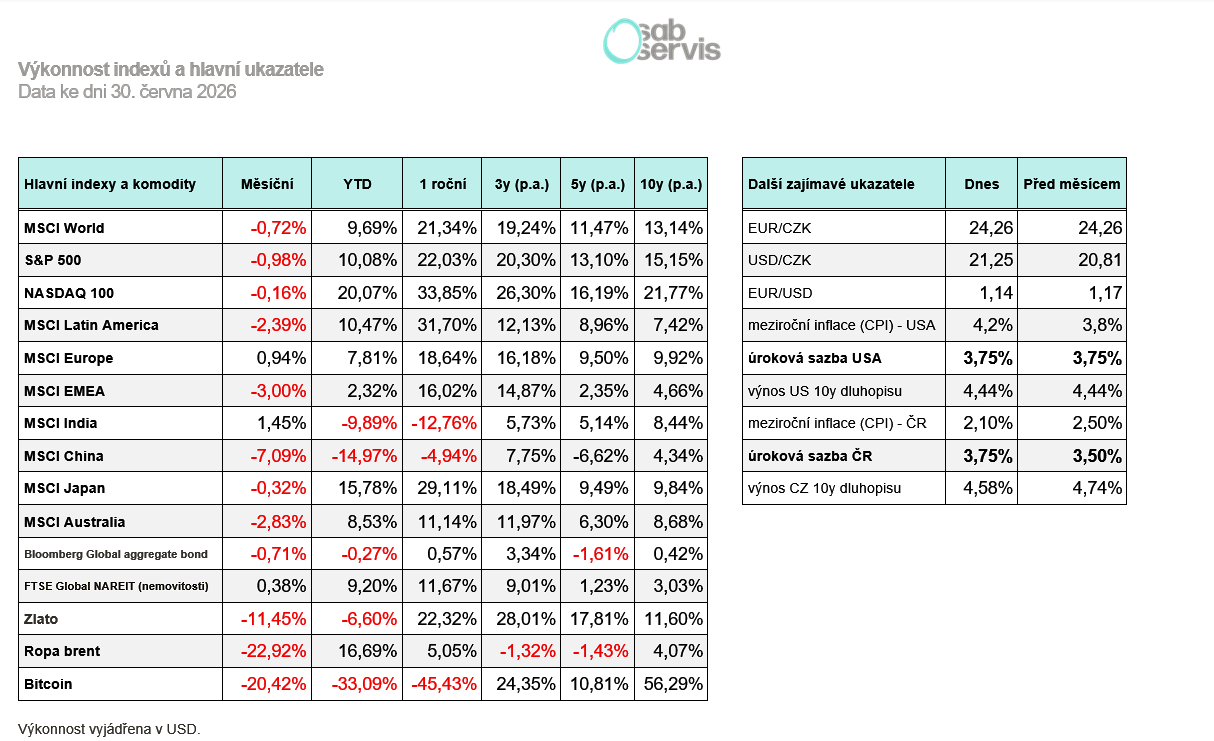
June was a fairly volatile month, with stocks initially falling by several percent. Specifically, the S&P 500 index fell by as much as 5% and the technology NASDAQ by nearly 10%. For the rest of the month, stocks then moved sideways, and we are now close to the highs again.
The reason for the correction was probably expectations regarding interest rate increases in the US, as well as a slight cooling after the major growth of semiconductor companies in recent months.
However, a major breakthrough occurred in mid-June, when an agreement between the US and Iran was signed. A ceasefire was therefore concluded, and in the following weeks the issue of Iran’s nuclear programme will be addressed. The Strait of Hormuz is now completely open, or at least it should be. In reality, fewer ships are still passing through than before the conflict began. Oil has already responded with a sharp decline, and we are now at a price below USD 70.
And how did other assets perform? Gold continued to decline during June, from the original USD 4,300 to the current USD 4,100. There is no longer as much interest in precious metals as there was just a few months ago.
Bitcoin fell from USD 70,000 in May to as low as USD 58,000 during June. It is currently trading around USD 62,000, so we are still roughly 50% below the highs.
Macro summary:
But let us move on to the important macroeconomic indicators and start with the year-on-year inflation rate in the Czech Republic, which came in at 2.1% for May. This was a fairly surprising decrease, as inflation growth to as much as 3% had been expected until recently, which is no longer a risk now.
On 18 June 2026, a CNB meeting took place, which brought a surprising increase in interest rates from 3.5% to 3.75%. This came after a pause of more than a year, during which the CNB kept interest rates at 3.5%. By the end of the year, the CNB will probably raise rates once more.
The year-on-year inflation rate for May in the US came in as high as 4.2% due to high oil prices. Fuel prices therefore clearly have a greater impact in the US than they do here in the Czech Republic. However, the price of oil fell sharply below USD 70 during June, so inflationary pressures should gradually subside.
June data on unemployment in the US came in at 4.2%, in line with expectations. However, the number of new jobs created (NFP) for June was lower, at only 57,000.
The Fed would therefore not need to be so strict with interest rate increases if inflation were to decline and labour-market figures remained at these levels. However, at the latest meeting on 17 June, under its new chairman, it signalled a reversal: instead of cuts, 1 to 2 interest rate increases are expected in the future.
As for year-on-year inflation results in Europe, the figure for May came in at as much as 3.2%. An increase to as much as 3.5% is expected in the coming months. At its latest meeting on 11 June, the ECB therefore raised interest rates from 2.15% to 2.4%. It will probably continue raising interest rates by the end of the year.
Czech Republic:
The year-on-year inflation rate in the Czech Republic came in at 2.1% for May. This was a fairly surprising decrease, as inflation growth to as much as 3% had been expected until recently, which is no longer a risk now.
On 18 June 2026, a CNB meeting took place, which brought a surprising increase in interest rates from 3.5% to 3.75%. This came after a pause of more than a year, during which the CNB kept interest rates at 3.5%. By the end of the year, the CNB will probably raise rates once more.
Interest rate in the Czech Republic (development and forecast)
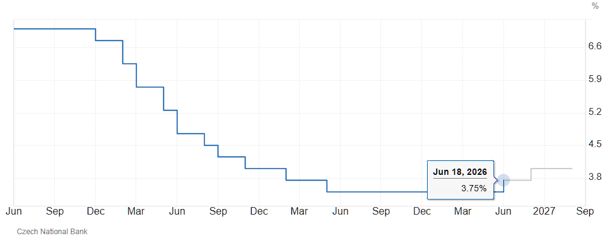
Source: cnb.cz
The reason for the interest rate increase is not inflation, but above all the continued growth in real-estate prices and demand for new loans. The CNB is trying to curb this through this measure. Further rate increases by the end of the year cannot be ruled out either.
However, the average interest rate on mortgages continues to rise, reaching as much as 5.3% in June according to the hypoindex. It certainly does not look like interest rates will be reduced anytime soon.
USA:
The year-on-year inflation rate for May in the US came in as high as 4.2% due to high oil prices. Fuel prices therefore clearly have a greater impact in the US than they do here in the Czech Republic. However, the price of oil fell sharply below USD 70 in June, so inflationary pressures should gradually subside.
June data on unemployment in the US came in at 4.2%, in line with expectations. However, the number of new jobs created (NFP) for June was lower, at only 57,000.
The Fed would therefore not need to be so strict with interest rate increases if inflation were to decline and labour-market figures remained at these levels.
Interest rate in the USA (current forecast)
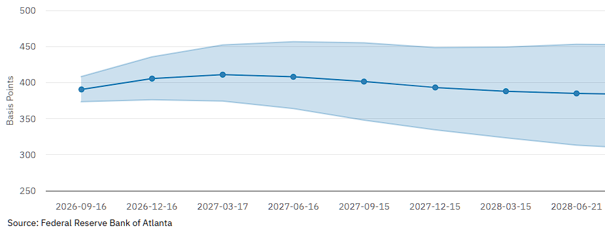
At the latest meeting on 17 June, led by the new Fed chairman, the interest rate was kept at 3.75% for the time being.
However, there was a reversal, with 1 to 2 interest rate increases expected by the end of the year instead of the previous cuts.
Fed chairman Kevin Warsh also newly announced that they would not provide so-called forward guidance and would therefore not be as transparent as under Jerome Powell, which may unsettle investors in the future.
The S&P 500 index ultimately declined slightly by less than 1% during June. We are currently at levels around USD 7,500.
Europe:
As for year-on-year inflation results in Europe, the figure for May came in at as much as 3.2%. An increase to as much as 3.5% is expected in the coming months.
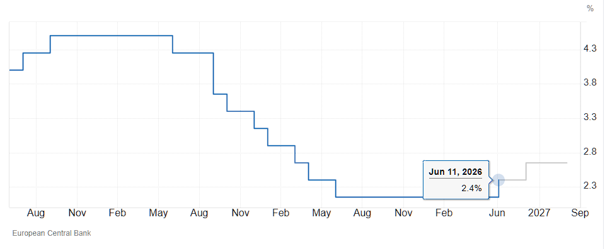
ECB interest rate – forecast
Source: www.www.tradingeconomics.org
The ECB therefore raised interest rates from 2.15% to 2.4% at its latest meeting on 11 June. It will probably continue raising interest rates by the end of the year. It is therefore the first major central bank to take this step, even before the Fed.
European stock indices rose only slightly by less than 1% during June, as measured by the MSCI Europe index in US dollar terms.