Main events:
• Minor stock market correction after a major rise
• The Fed will raise interest rates
• The Ministry of Finance of the Czech Republic issues Republic Bonds 2026 (when to include them in a portfolio?)
Summary of the current situation:
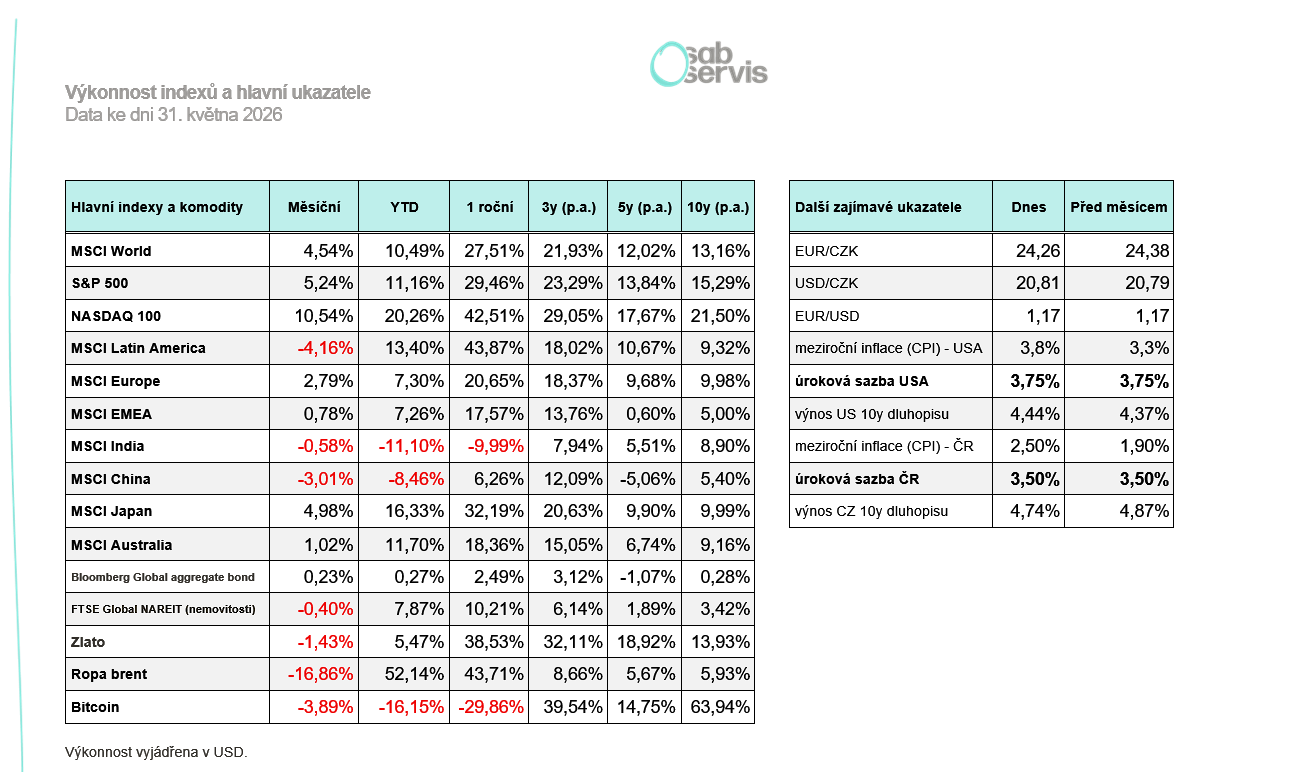
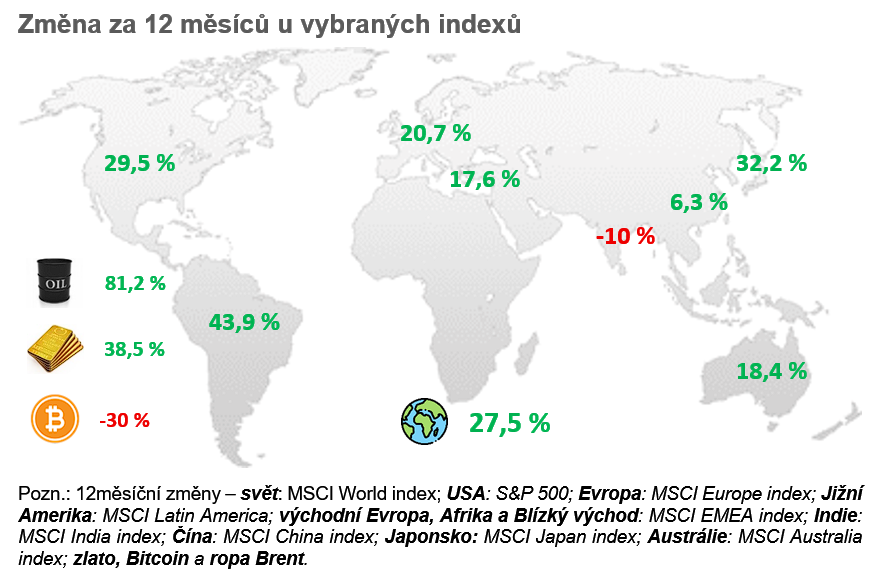
During May, we continued the previous successful month, and the S&P 500 stock index immediately gained 5%. We kept reaching new highs, at one point as high as USD 7,600, and since the beginning of the year the S&P 500 index had returned as much as 10%.
The reason for the growth was the successful earnings season and the continuing AI boom. It was particularly successful for so-called AI infrastructure companies, meaning data center memory, servers, energy companies, and everything around that. Whether it was Micron, AMD, or also Dell, HP and others. Investors appear to be discovering more and more companies whose revenues are growing thanks to demand for data centers.
However, last Friday, 5 June 2026, this growth came to a temporary end, and some stocks fell by more than 10% in a single day. The S&P 500 index lost 2.5% and the technology-heavy NASDAQ as much as 5%.
What was the reason? The trigger was probably Friday’s US unemployment data (NFP). The number of new jobs significantly exceeded expectations and confirmed the strength of the US economy, which ultimately means that the Fed will definitely not be able to cut interest rates, but will instead be more likely to raise them in order to curb economic growth.
Among other things, this triggered Friday’s stock sell-off. But one reason was also their recent strong growth, as stock indices had risen over the past two months without any major pause. We will see how developments continue, but for now it does not appear to be any major decline or cause for concern, only a normal mini-correction.
And how did other assets perform? Gold declined slightly during May and did not remain calm during Friday’s declines either. During May, it fell from USD 4,500 to the current USD 4,300.
Bitcoin declined slightly during May and stood at around USD 73,000 at the end of the month. However, during the first week of June it declined mainly due to outflows from ETFs and also due to a smaller sale by Michael Saylor through MicroStrategy, despite the fact that he had declared from the beginning that he would never sell. He has now been forced to do so because of a dividend payment.
Bitcoin was not spared Friday’s sell-off either, and at times it even fell below the USD 60,000 level. For long-term investors, this is therefore an attractive opportunity for an initial entry or to increase their position.
Macroeconomic summary:
Let us now turn to key macroeconomic indicators and begin with the year-on-year inflation rate in the Czech Republic, which came in at 2.5% for April. A slight increase to as much as 3% is still expected in the coming months, precisely as a result of high oil and fuel prices.
On 7 May 2026, the Czech National Bank held its meeting and left interest rates at 3.5%. We are almost certainly not expecting rate cuts, and rather a slight increase in interest rates is expected in the coming months by the end of the year, precisely due to rising inflation.
The year-on-year inflation rate for April in the US came in at as much as 3.8% – due to high oil prices. A slight increase is expected in the coming months, as oil remains between USD 90 and USD 100.
April and May unemployment data in the US came in at 4.3%, in line with expectations. However, the surprise was the number of new jobs for May (NFP), which amounted to 172,000 compared with the expected 85,000.
At the same time, the figures for April and March were also revised upwards, which means that the US economy remains robust and there are no problems in the labor market. The Fed will therefore definitely not be able to cut interest rates, but will instead be more likely to raise them in order to curb economic growth.
As for year-on-year inflation results in Europe, the figure for April came in at as much as 3%. An increase to as much as 3.5% is expected in the coming months. The ECB will therefore be forced to raise interest rates, and we are likely to see two interest-rate increases by the end of the year.
Czech Republic:
The year-on-year inflation rate in the Czech Republic came in at 2.5% for April. A slight increase to as much as 3% is still expected in the coming months, precisely as a result of high oil and fuel prices.
On 7 May 2026, the Czech National Bank held its meeting and left interest rates at 3.5%. We are almost certainly not expecting rate cuts, and rather a slight increase in interest rates is expected in the coming months by the end of the year, precisely due to rising inflation.
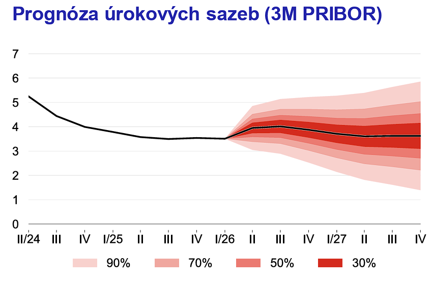
Source: cnb.cz
Current yields on 5-year government bonds remain above 4%, and the average interest rate on mortgages is above the 5% threshold.
The major news during May is the issue of Republic Bonds, in which individuals can invest directly until the end of June.
We have provided more information, including our recommendation on how to work with the issue, in the myDock news item dated 19 May 2026 – Republic Bond 2026 – summary. From our perspective, the interest rate set here is quite attractive, and most importantly, the interest income is exempt from the 15% withholding tax.
USA:
The year-on-year inflation rate for April in the US came in at as much as 3.8% – precisely due to high oil prices. A slight increase is expected in the coming months, as oil remains between USD 90 and USD 100.
April and May unemployment data in the US came in at 4.3%, in line with expectations. However, the surprise was the number of new jobs for May (NFP), which amounted to 172,000 compared with the expected 85,000. At the same time, the figures for April and March were also revised upwards, which means that the US economy remains robust and there are no problems in the labor market. The Fed will therefore definitely not be able to cut interest rates, but will instead be more likely to raise them in order to curb economic growth.
US interest rate (current forecast)
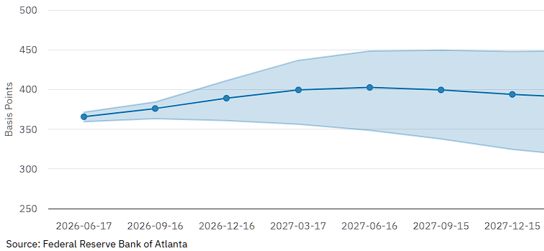
It is currently expected that the Fed could raise interest rates 1–2 times by the end of the year, to as much as 4.25%. However, everything will depend on the level of inflation and the impacts of high oil prices.
The S&P 500 index rose by as much as 5.24% during May, reaching new highs at USD 7,600.
Europe:
As for year-on-year inflation results in Europe, the figure for April came in at as much as 3%. An increase to as much as 3.5% is expected in the coming months. The ECB will therefore be forced to raise interest rates, and we are likely to see two interest-rate increases by the end of the year.
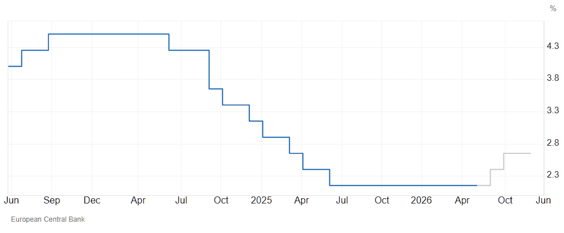
ECB interest rate – forecast
Source: www.www.tradingeconomics.org
It is currently expected that we could rise from the current 2.15% to as much as 2.65%. The ECB could be the first central bank to begin raising interest rates during this period.
European stock indices rose only slightly during May, and the MSCI Europe index gained 2.79% in US dollar terms.